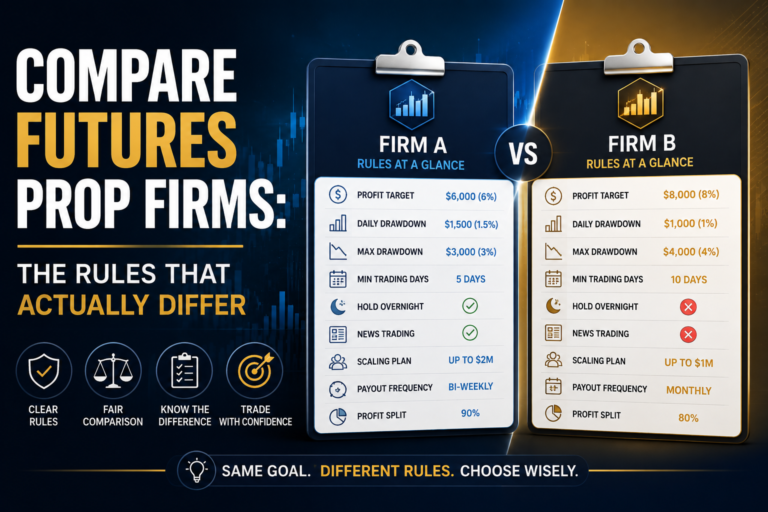

Breaking into futures prop trading as a beginner is fraught with misconceptions. Aggressive marketing campaigns promote five- and six-figure funding balances alongside 90% profit splits, leading novice traders to believe they have massive capital to trade. In practice, a $50,000 evaluation account offers no such thing. Your actual cushion before account liquidation is bounded entirely by the maximum drawdown — typically $2,000 to $2,500.
For a beginner, the most important criterion when choosing an evaluation is not the advertised starting capital or the highest headline split. It is how forgiving the rule structure is when you inevitably make early execution errors. A single harsh drawdown model or an aggressive daily loss limit can wipe out weeks of steady progress in seconds.
This guide explains what actually makes a futures prop firm suitable for beginners, highlights the primary hidden traps that eliminate novice accounts, and compares the top beginner-friendly firms reviewed across our platform. For an introduction to fundamental concepts, see What Are Futures Prop Firms and our comparisons hub.
What Beginner-Friendly Actually Means in Futures Prop Trading
Most comparison sites label a prop firm “beginner-friendly” simply because its entry price is low. That is one of the most dangerous metrics a new trader can rely on. A $30 evaluation account that uses an intraday unrealized trailing drawdown and a strict daily loss cap will cost you far more in repeated resets than a $150 account with static risk parameters.
A genuinely beginner-friendly futures evaluation possesses four structural characteristics:
- End-of-Day (EOD) or Static Drawdown: The loss limit only recalculates when the market closes, meaning intraday open profit spikes do not trail your failure floor upward while a trade is running.
- No Intraday Daily Loss Limit (or a generous one): Many beginners suffer early exits because a single volatile swing breaches an artificial daily cap, even though their overall account balance is well within the maximum drawdown allowance.
- Micro Contract Flexibility: Full access to CME Micro contracts (MES, MNQ, MYM, MCL) without arbitrary scaling penalties, allowing true 1:1 risk sizing.
- Accessible Platforms: Integrated, zero-setup execution environments such as TradingView, Tradovate, or ProjectX, eliminating complicated Rithmic setup friction.
Drawdown Types: The Primary Hurdle for New Traders
Understanding drawdown architecture is the single highest leverage skill for passing an evaluation. Prop firms employ three main drawdown methods:
1. Intraday Trailing Drawdown (Highest Difficulty): This model trails your peak unrealized equity in real time. If you enter an NQ long that rallies +$1,200 and then pulls back to flat before your target, your drawdown floor has moved up by $1,200 permanently. You gave back open profit, but the firm treated it as realized equity. Beginners almost universally fail this model within five sessions.
2. End-of-Day (EOD) Trailing Drawdown (Moderate Difficulty): The trailing floor only adjusts at the 5:00 PM ET market close based on your settled balance. Open intraday fluctuations do not ratchets your trailing stop upward. This gives novice trades room to breathe during typical pullbacks.
3. Static Drawdown (Lowest Difficulty / Best for Beginners): The failure threshold remains fixed at the starting level (for instance, starting balance minus $2,000) and never trails upward, regardless of how much profit you make. You can build a genuine risk buffer and trade with peace of mind.
Where Beginners Lose Money: The Reset Trap
The economic model of budget prop firms relies heavily on evaluation resets. Firms discount their initial challenge fee by 70% to 90%, drawing in novice traders. However, because the rules are configured with high friction — tight intraday trailing drawdowns and strict daily limits — the average beginner fails within 3 to 7 trading days.
The trader is then presented with a paid reset option (typically $80 to $100). A novice who bought a challenge for $35 can easily spend $300 to $500 in resets before passing or abandoning the account. Understanding this dynamic shifts your perspective: paying a slightly higher initial fee for a static or EOD account is vastly more economical over the lifecycle of your qualification. For detailed math, check our True Cost to Funding breakdown.
Beginner-Friendly Futures Prop Firms Compared
The table below compares the leading evaluation programmes across our reviews based on the specific metrics that matter to novice traders.
| Firm | Recommended Size | Drawdown Mechanism | Daily Loss Limit | Micro Contract Sizing | Platform Setup | Reset Fee | Review & Rating |
|---|---|---|---|---|---|---|---|
| Topstep | 50K Trading Combine | End-of-Day Trailing | $1,000 (Soft Breach) | Up to 50 Micros | TradingView / Tradovate | $49 – $99 | Read Topstep Review |
| Tradeify | 50K Growth / Lightning | End-of-Day / Static Options | None on select tiers | Up to 40 Micros | Tradovate / NinjaTrader | $85 | Read Tradeify Review |
| Bulenox | 25K / 50K Option 1 | End-of-Day Trailing | None on Option 1 | Up to 30 Micros | NinjaTrader / Rithmic | $78 | Read Bulenox Review |
| FundedNext Futures | 25K Starter | Static / EOD Tiered | Present (Session based) | Standard CME Micros | TradingView / MT5 | $65 | Read FundedNext Review |
| Apex Trader Funding | 50K Full | Intraday Trailing (Higher Risk) | None | Up to 50 Micros | Tradovate / NinjaTrader | $80 (or Sale Reset) | Read Apex Review |
Who a Beginner Evaluation Programme Suits
- Traders transitioning from Demo to Live Risk: Evaluating on a prop account caps your absolute financial downside to the subscription cost while testing your emotional discipline under rule restrictions.
- Micro Contract Scalpers and Day Traders: Those who execute small size on MES or MNQ and need a realistic platform environment without deploying thousands in personal broker capital.
- Process-Oriented Traders Developing Consistency: The daily caps and minimum day requirements force structure and prevent emotional revenge trading when managed properly.
Who Should Avoid Prop Firm Evaluations Right Now
- Traders without an established edge: If you cannot generate a positive expectancy in a 30-day paper trading simulation, buying an evaluation account is a guaranteed loss.
- Swing traders holding positions overnight: Futures prop evaluations generally mandate flat positions by 4:59 PM ET. If your strategy requires multi-day holds, standard futures prop models will automatically breach your account.
- Traders with insufficient risk capital for monthly fees: While cheaper than direct CME margin requirements, subscriptions recur monthly until passed or canceled.
Essential Checklist for Beginners Before Buying an Evaluation
Before entering your credit card details on any prop firm site, audit these seven specific terms:
- Drawdown Calculation Mode: Confirm in writing whether the drawdown trails live unrealized tick-by-tick equity or settles at daily market close (EOD).
- Daily Loss Limit Rules: Does hitting the daily loss limit close open positions and lock the account until tomorrow (soft breach), or does it completely fail the evaluation (hard breach)?
- Consistency Rule at Evaluation and Payout: Does the firm require that no single day constitutes more than 30% or 40% of total profits? If yes, a novice with one windfall day will find payouts locked until more volume is traded.
- Activation and Data Surcharge Fees: Check whether passing triggers a mandatory one-time activation fee ($130–$150) or recurring monthly exchange data fees on the funded stage.
- Minimum Trading Days: Ensure the programme permits qualification within your realistic trading frequency.
- News Trading Policies: Confirm whether trading through high-impact macroeconomic releases (FOMC, CPI, NFP) is allowed or triggers instantaneous contract liquidation.
- Payout Frequency and Minimum Buffers: Review the funded account payout policy, specifically the required safety buffer before first withdrawals are permitted.
Position Sizing and Contract Mechanics for Novices
Position sizing is the primary reason beginners breach accounts. On a standard E-mini S&P 500 (ES) contract, each point represents $50. A standard 10-point pullback represents a $500 loss. On a $50,000 account with a $2,000 maximum drawdown, two consecutive losing trades of this magnitude consume 50% of your total account life.
By contrast, trading Micro E-minis (MES) at $5 per point reduces your risk per point by 90%. A beginner trading 2 to 3 Micro contracts can absorb normal intraday volatility and respect statistical stop-losses without approaching the drawdown threshold. When evaluating, strictly trade Micros until your profit buffer exceeds $1,500 above the starting balance.
Simulated Environment vs Real Market Execution
It is vital for novice traders to recognize that evaluation accounts and most initial funded accounts operate on simulated demo feeds connected to real-time CME market data. The firm is not placing your orders on live exchange order books. Instead, you are paying a fee for an evaluation service.
Because order fills are simulated, slippage during volatile news releases may behave differently than on live accounts. Respect this boundary: treat the simulation with the seriousness of live capital, but do not assume infinite market liquidity on larger sizes.
Frequently Asked Questions
1. What is the easiest futures prop firm to pass for a beginner?
Firms utilizing End-of-Day (EOD) trailing drawdowns or static drawdowns without strict daily loss limits — such as Topstep or Tradeify — statistically offer the highest pass rates for novice traders compared to intraday trailing models.
2. How much money do I actually need to get started?
Most entry-level 25K or 50K evaluation accounts cost between $35 and $150 per month after coupon discounts. However, you should budget for at least two to three months of evaluation subscription costs to account for early learning curves.
3. Can I trade Micro contracts on all prop accounts?
Yes, nearly all major futures prop firms support CME Micro contracts (MES, MNQ, MYM, MCL). Check the firm’s contract scaling table to verify exact maximum allowances.
4. What happens if I fail an evaluation account?
If your account balance breaches the maximum drawdown or daily loss threshold, trading is disabled. You can either purchase a paid reset to restart the account balance or wait for the monthly renewal cycle to reset it automatically.
5. Is Topstep good for complete beginners?
Topstep is widely regarded as one of the best starter firms due to its intuitive platform integration with TradingView, End-of-Day drawdown calculation, structured coaching resources, and transparent payout policies.
6. What is the difference between a hard breach and a soft breach?
A soft breach typically closes your active positions and locks your account until the next daily session (often applied to daily loss limits). A hard breach permanently fails the evaluation, requiring a paid reset or fresh purchase.
7. Do I have to pay taxes on funded prop firm payouts?
Yes. Payouts received from prop firms are typically treated as 1099 independent contractor income (in the US) or self-employed commercial income, rather than Section 1256 capital gains contracts. Always consult a tax professional.
8. Can I hold trades overnight?
Generally no. Futures prop evaluations require all open positions to be flattened prior to the electronic market close (usually 4:59 PM ET). Holding through the close results in an immediate rule breach.
9. Which trading platform should a beginner choose?
TradingView and Tradovate are the easiest for novices to configure, requiring no complex API connections or license keys. NinjaTrader offers advanced order flow charting but has a steeper initial learning curve.
10. Does a 90% profit split mean I get 90% immediately?
Most firms offer 100% of the first $5,000 to $10,000 in payouts, after which the split transitions to 80% or 90%. Always review the withdrawal schedule and minimum account buffer requirements.
11. What is an activation fee?
An activation fee is a one-time fee (typically $130 to $150) charged by certain firms once you pass the evaluation to set up your funded simulated account. Other firms charge recurring monthly exchange data fees instead.
12. Can I use automated trading bots or algorithms?
Most firms allow basic algorithmic execution and trade copiers across your own accounts, provided they do not exploit latency arbitrage, tick-scalping glitches, or high-frequency quote stuffing.
13. How long do I have to pass the evaluation?
Most modern futures prop firms have no maximum time limit. As long as your monthly subscription is maintained and you meet the minimum trading days (often 0 to 5 days), you can trade at your own pace.
14. Why is static drawdown safer for beginners?
Because a static drawdown never moves up from its initial floor. If you start with $50,000 and a $2,000 static drawdown, your failure level is permanently $48,000. As you make profit, your risk cushion expands rather than trailing behind you.
15. What is the consistency rule?
The consistency rule mandates that no single trading session can account for more than a specified percentage (e.g., 30% or 40%) of your total accumulated profit upon payout request. It ensures your results stem from a repeatable strategy rather than a single lucky gamble.
Conclusion: How to Approach Your First Evaluation
Passing your first futures prop firm evaluation requires treating it as an exercise in strict risk management rather than a race to get rich. Choose an evaluation model with an End-of-Day or static drawdown, size exclusively in Micro contracts, avoid high-impact news spikes, and protect your capital base above all else.
Explore our One Step Evaluation Hub to compare single-phase challenges, or check active discounts on our coupons directory before starting your challenge.